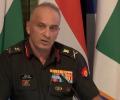
The Pakistan Army has accused India of attempting to manipulate history by creating fabricated narratives, following claims by the Indian Army regarding Pakistani casualties along the Line of Control.

Pakistan seized 19 Afghan military posts and "terrorist hideouts" in response to alleged attacks by Afghan forces. Kabul claims significant Pakistani casualties. Tensions escalate following repeated attacks by the Tehreek-e-Taliban Pakistan (TTP).
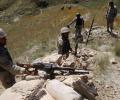
Pakistan responded to what it called 'unprovoked' attacks by Afghan forces in border areas, destroying several Afghan border posts, training camps, and terrorist hideouts, security sources said on Sunday.

Pakistan summoned the Afghan ambassador to convey its strong reservations over the India-Afghanistan joint statement issued in New Delhi, particularly regarding references to Jammu and Kashmir.

The development comes as relations between the two countries showed marked improvement following the four-day military conflict between Pakistan and India in May.
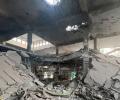
The Pakistan Army has criticized recent remarks by Indian military officers and political leaders, warning that a future conflict between the two countries could lead to "cataclysmic devastation." The statement follows comments from Indian officials regarding India's ability to cross borders and the potential for military action against Pakistan.

A strike in Pakistan-occupied Kashmir (PoK) over unfulfilled demands turned violent, resulting in one death and multiple injuries. Mobile and internet services have been suspended in the region.

US President Donald Trump met with Pakistan Prime Minister Shehbaz Sharif and Field Marshal Asim Munir at the White House to discuss bilateral ties. This was the first formal bilateral interaction between Trump and Sharif.

The Quetta-bound Jaffar Express was targeted in the Spizend area of Mastung on Tuesday, latest in a series of attacks that have targetted this train since March this year.
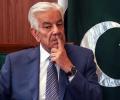
The entry of other Arab countries in the mutual defence deal between Pakistan and Saudi Arabia is not ruled out, Defence Minister Khawaja Asif has said, adding that 'doors are not closed' for such developments.

Saudi Arabia and Pakistan have signed a 'Strategic Mutual Defence Agreement', pledging that any aggression against either nation would be treated as an attack on both.
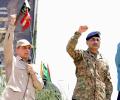
The meeting, expected on September 25 on the sidelines of the UN General Assembly, will also be attended by army chief Field Marshal Asim Munir.

Dar recalled that when he met US Secretary of State Marco Rubio in July and asked about dialogue with India, the top US diplomat clarified that India has maintained it is a "bilateral issue."

At least 19 soldiers and 45 militants have been killed in clashes in Pakistan's restive northwest, with Prime Minister Shehbaz Sharif vowing to respond with full force against the terrorists. The Pakistan army reports clashes in Khyber Pakhtunkhwa province. Sharif alleges terrorist leaders operate from Afghan soil and calls for repatriation of illegal Afghan residents.
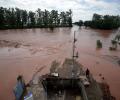
Pakistan has urged India to fully adhere to the Indus Water Treaty (IWT), expressing concerns about the level of detail in flood information shared through diplomatic channels.

Hydrology experts suggest that India cannot be directly blamed for the devastating monsoon flooding in Pakistan this year, citing greater destruction upstream of the border and lack of evidence for intentional action.

China showcased its latest military hardware, including hypersonic and ballistic missiles, during a parade commemorating the 80th anniversary of its victory against Japanese aggression in World War II. President Xi Jinping called for world peace and national rejuvenation.
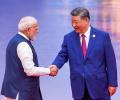
A senior Chinese Communist Party official stated that the meeting between Prime Minister Narendra Modi and President Xi Jinping was fruitful, leading to a new consensus on developing bilateral relations. Both countries aim to enhance cooperation and manage differences.
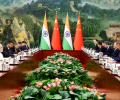
Chinese President Xi Jinping told Prime Minister Narendra Modi that India and China should approach their relations from a "strategic" and "long-term perspective" during their talks in Tianjin. Xi also emphasized upholding multilateralism and working towards a multipolar world.

Prime Minister Narendra Modi and Chinese President Xi Jinping are expected to hold bilateral meetings on the sidelines of the SCO summit in Tianjin, as both nations look to strengthen ties amid global trade tensions.
 © 2025 Rediff.com - Investor Information - Advertise with us - Disclaimer - Privacy Policy - Sitemap - Feedback - About us - Terms of use - Grievances